
Effective alumni engagement requires institutions to move beyond broad outreach and consider alumni as a distinct and nuanced stakeholder group. By understanding how alumni differ from other key university stakeholders, and by factoring in their unique forms of institutional affinity, higher education leaders can drive greater impact with programming, communications, and philanthropic strategy.
Understanding the University Stakeholder Map
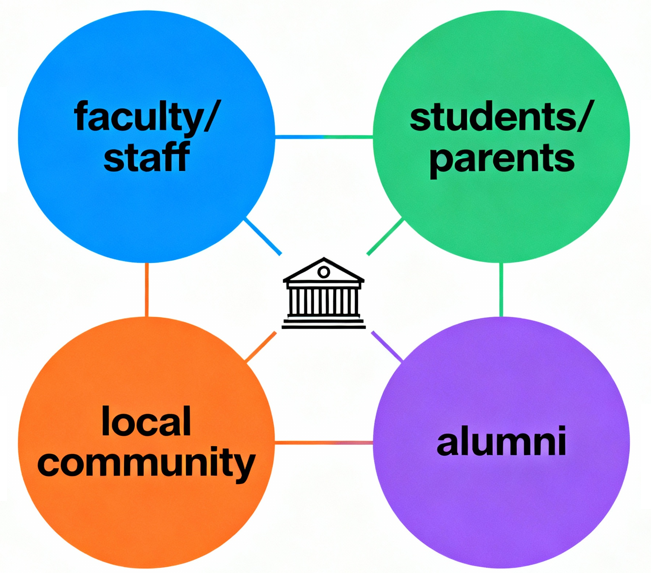
Every university relies on four primary stakeholder groups:
Faculty and Staff: Individuals whose livelihood and professional success are tied directly to the institution. Their interest is naturally aligned with the university’s sustained growth and prosperity.
Students and Their Parents: Stakeholders who are invested in the tangible and intangible value of the institution, believing their time, effort, and financial investment will translate into an enduring, reputable degree.
The Community: Local and regional populations benefit from the university’s economic, cultural, and developmental contributions, from employment pipelines and research partnerships to arts, sports, and entertainment programming.
Alumni: Graduates who, after completing their studies, lose a transactional or economic tie to the institution, but often become its most impactful supporters through both financial contributions and volunteer engagement.
While some individuals belong to several groups, faculty who are also alumni, parents who are staff, or community leaders who are donors, the lines of distinction remain vital for shaping institutional strategy.
Alumni: Affinity Without Transaction
What sets alumni apart is their lack of a direct, everyday economic relationship with the institution. They don’t receive a paycheck, may live far from campus, and often retain no immediate stake in the local community. However, despite this distance, alumni are historically the biggest source of voluntary support by donating time, advocacy, and philanthropic dollars over the course of decades.
This distinctive status can be both a challenge and an opportunity. Unlike other stakeholders, alumni affinity isn’t derived from current economic exchange; it’s anchored in lasting emotional ties, campus memories, life outcomes, and pride in their degree. This reality means alumni engagement is as much about cultivating long-term affinity as it is about meeting immediate institutional needs.
Segmenting Alumni by Stakeholder Overlap and Affinity
A one-size-fits-all approach to alumni is insufficient. It’s essential to consider the ways in which alumni may overlap into other stakeholder categories.
Alumni who are also parents of current students naturally possess heightened institutional affinity and deserve distinct communications and stewardship during their child’s enrollment.
Faculty and staff who are alumni are more likely to collaborate on alumni programs, champion the institution, and engage at higher rates than non-alumni colleagues.
Understanding these intersections supports targeted, relationship-driven approaches. Attitudinal profiling by identifying what alumni value about their experience and current relationship to the school empowers advancement professionals to design segments, programs, and content that maximize buy-in and impact.
Insights from Attitudinal Research: Data-Driven Strategy for Impact
With a database of over one million alumni responses from 350+ institutions, the evidence is clear: the most effective engagement and giving strategies are grounded in metrics, not assumptions. Using survey-derived attitudinal profiles, institutions can:
-Map alumni by affinity level and stakeholder overlap for precision targeting.
-Tailor engagement programs and communications to address the motivators proven to drive impact in each subgroup.
-Foster greater campus buy-in, as data-driven programs demonstrate higher success rates and can unite faculty, staff, and leadership around common engagement goals.
Viewing alumni as a unique, data-profiled stakeholder group with varied affinity levels is no longer just theoretical. It is a proven approach to maximizing engagement and support. Attitudinal research and stakeholder modeling unlock new levers for advancement teams, enabling smarter segmentation, more meaningful communications, and growth in both volunteerism and philanthropy. Embracing this framework positions institutions to harness alumni passion while building a stronger, more connected campus community for the future.
For more content about alumni engagement data trends, check out our blog Alumni Insights.