
A stronger alumni events strategy is not just about offering more programs; it is about offering the right mix of formats, topics, and access points for different alumni segments. National practice increasingly points toward hybrid models that combine in-person, virtual, regional, and on-demand elements, reflecting the diverse realities of young alumni, mid‑career professionals, retirees, and graduates who live both near and far from campus. Using the right data can guide institutions in determining which alumni are most likely to participate, what kinds of programming matter most to them, and where unmet demand may exist.
Alumni Realities and the Case for Hybrid 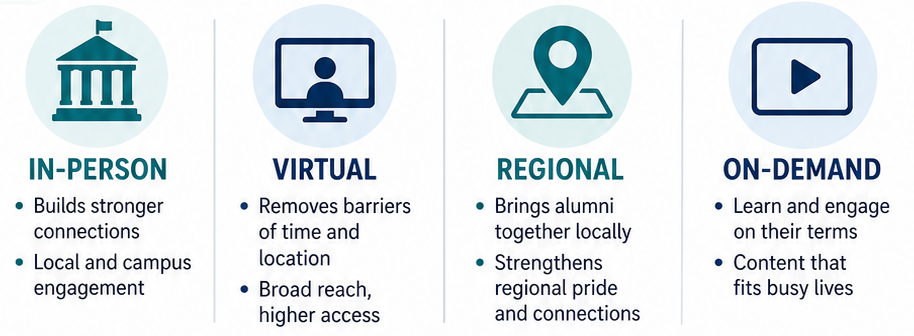

Alumni Attitude Study results highlight that alumni audiences are highly varied in both time availability and geographic location. Young alumni report limited time and competing priorities, mid‑career alumni are balancing work and family, and retirees show different interests and schedules. Many alumni live hundreds of miles from campus. No single event format fits all of these situations. Blending digital and in‑person options, regional access, and flexible follow‑up content better reflects how alumni actually live and work today.
Effective hybrid events are built around access and engagement, rather than duplication. Alumni Attitude Study responses indicate that virtual participants value meaningful ways to interact and be seen, while in‑person attendees are more likely to deepen their connection when events are paired with recordings, digital resources, or clear next steps that extend the relationship beyond a single evening. Taken together, the data suggests that alumni programming works best as a portfolio of experiences, not a string of one‑off events.
What Alumni Say About Different Program Types
Alumni report different levels of interest in specific types of programming. Likelihood of participation varies across options, such as mentoring students or young alumni, networking events, career development programs, lifelong learning opportunities, online alumni clubs, community service projects, chapter dinners, reunions, and alumni travel. The pattern is consistent: demand is not evenly distributed across formats or across alumni groups.
Correlation analyses from the Alumni Attitude Study add another layer. The data shows that certain activities are more closely associated with higher affinity and ongoing involvement. Attending athletic events has a positive relationship with affinity, but so do mentoring students or young alumni, participating in community service with alumni, recruiting students, and helping to raise funds. These results suggest that some program types may be especially important because they are linked to stronger long‑term institutional connection, even if their attendance numbers are smaller than large social gatherings.
Different Segments, Different Interests
Segmentation results reveal that interest in programming differs by donor status, degree type, distance from campus, race and ethnicity, gender, and graduation decade. Some segments show higher interest in networking and career development, while others lean more toward reunions, chapter dinners, or travel. The findings underscore that alumni program demand is shaped by who alumni are, where they live, and what stage of life they are in.
Across institutions, several themes emerge about which event types are especially meaningful:
-Alumni often express strong interest in mentoring and career‑focused events, particularly younger and mid‑career cohorts.
-Lifelong learning and educational programming appeal to alumni who remain highly connected to the institution’s academic strengths.
-Community service and student‑facing opportunities resonate with alumni who are motivated by impact and mission.
-Traditional social events, reunions, and chapter dinners show enduring appeal for specific geographies and age groups, but not uniformly across all segments.
These findings suggest that networking, mentoring, and development‑oriented programming may carry outsized value for many alumni, while more social or tradition‑based events play targeted roles for certain cohorts.
Using Hybrid as a More Balanced Programming Portfolio
Taken together, the findings point toward a clear conclusion: hybrid programming, combining regional, virtual, and on‑campus elements, is better aligned with alumni realities than single‑format calendars. Alumni interest and likelihood to participate vary systematically by segment, and the activities most associated with affinity often extend beyond traditional reunions or large social events.
By showing how different alumni groups respond to specific event types, Alumni Attitude Study data offers a more nuanced picture of what “good programming” looks like. Rather than assuming all alumni want the same kinds of gatherings, the research reveals a layered landscape of preferences in which mentoring, career development, lifelong learning, and impact‑driven opportunities play central roles alongside more familiar celebrations.
For more content about alumni engagement data trends, check out our blog Alumni Insights.