
Part 1 of “Rethinking Alumni Strategy: Why Engagement and Giving Belong on the Same Map” Series
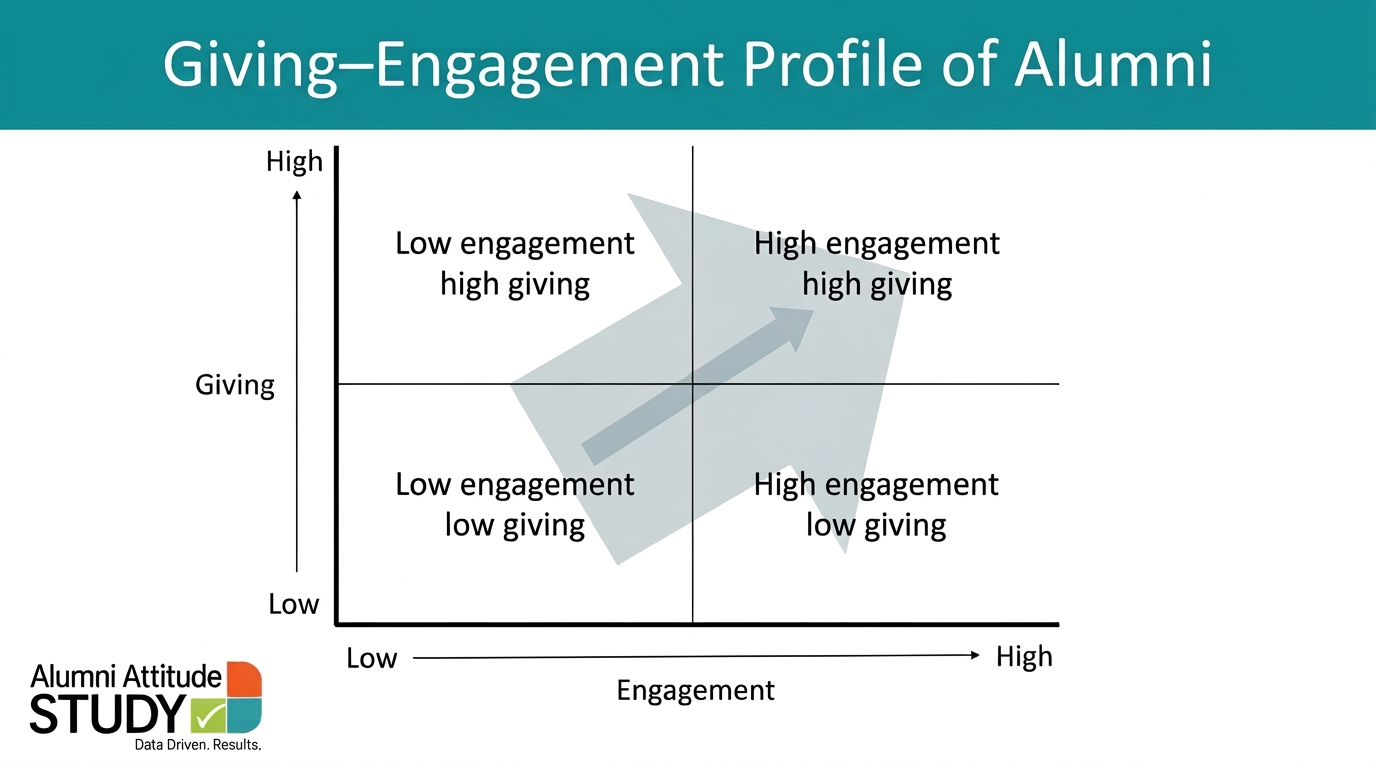
For years, many advancement teams have talked about “engagement” on one hand and “giving” on the other, as if they were separate scorecards. While CASE Insights on Alumni Engagement Survey identifies philanthropy as one of the four modes of engagement along with volunteering, experiential, and communication, this divide still persists at many institutions where giving and alumni engagement often remain as separate conversations.
However, our data suggests something different. When you put these two dimensions together on the same map, you see a much more useful picture of how alumni relate to their alma mater, and what you can do to strengthen that relationship over time.
At the Alumni Attitude Study, we do this by plotting engagement on one axis and giving status on the other, using alumni responses to a common set of questions and institutional donor records. The result is a simple but powerful way to understand where alumni are today and how to move more of them toward a deeper, more generous connection. Deepening alumni connections is more important than ever before as higher education continues to wrestle with the broader philanthropic trend of dollars up, donors down. New ways to identify engaged alumni and strengthen their connection to the institution offers an opportunity for advancement leaders to rebuild the pipeline.
Step 1: How We Define Engagement
In this model, engagement is not a vague sentiment. It is built from specific, observable behaviors alumni report in the survey, such as:
-Attending local alumni events or class reunions
-Volunteering on campus or at alumni programs
-Reading alumni emails and the alumni magazine
-Visiting the university or alumni website
-Attending sporting events or visiting campus
-Staying in touch with other alumni
Each behavior has its own pattern by class year, degree, and program, which is especially important as institutions look to better understand what matters to their Gen Z alumni.
When we aggregate them, we get a practical, data-based view of how engaged an alumnus is and not just whether they “feel good” about the institution.
Step 2: Adding Giving to the Picture
We then overlay a basic giving classification: current givers, lapsed givers, and never givers. When you cross that with low vs high engagement, four familiar groups emerge:
High engagement / high giving
High engagement / low giving
Low engagement / high giving
Low engagement / low giving
The strategic goal is straightforward: over time, we want more alumni living in the upper-right corner- higher engagement and higher giving. But the real value comes when we stop thinking of “the alumni base” as one monolithic audience and start thinking in terms of these distinct segments.
Step 3: What Each Quadrant Tells You
At a time when budgets are tight and questions about return on investment (ROI) abound, each quadrant answers a different question for your Alumni Relations team to help focus their strategic priorities and daily activities:
High engagement / high giving
These alumni are your “proof of concept.” They are participating, paying attention, and investing financially. They often serve as volunteers, mentors, and advocates. Your task here is to keep the relationship strong, celebrate their efforts, and give them easy ways to lead.
Low engagement / high giving
These alumni give, but they are otherwise on the margins of your engagement initiatives. For many institutions, this group is larger than expected. The risk is obvious: if their only touchpoint is a gift, they are more vulnerable to lapsing. The opportunity is to invite them into well-scoped, targeted forms of engagement that fit their lives (e.g. one time volunteer opportunities or online events).
High engagement / low giving
This group cares about the institution, but it has not yet translated that into philanthropy. They show up, read, connect, and participate. Their attitudes and behaviors tell us they are listening. The question is whether your giving asks are aligned with what they value.
Low engagement / low giving
Every institution has a sizable share of alumni here. Many are recent graduates who have not yet formed strong habits of engagement or giving. Others have drifted away over time. They are not “lost causes.” They simply need a different starting point- often a re‑introduction to people, programs, and stories that matter to them and a reason to stay connected to their institution (e.g. what’s in it for them).
When we look across multiple institutions, the shape of these quadrants changes, but the basic pattern holds alumni are not all at the same stage, and our strategies should reflect that.
Where We Go From Here
We are now working with Liz Rothenberg, PhD, of Rothenberg Research to expand on this framework and take the analysis to a new level by digging deeper into how attitudes, demographics, and behaviors interact inside each quadrant. That work is already surfacing practical insights for alumni engagement and advancement teams.
In future posts, we will share what we are learning from this collaboration, including an enhanced service that provides even more clarity about where your opportunities are and how to coordinate engagement and giving strategies around them. Watch for upcoming blogs, as we continue to unpack these findings and translate them into concrete steps you can use on your campus.
For more content about alumni engagement data trends, check out our blog Alumni Insights.