

In a competitive landscape where alumni engagement and philanthropic outcomes increasingly depend on personalization, colleges and universities need more than generic approaches to outreach. Data-driven insight is the foundation of effective engagement. The development and use of the Alumni Attitude Study’s Alumni Attitudinal Indices (AAI) and related “Indices of Interest” represent a breakthrough in understanding, segmenting, and communicating with alumni populations in ways that truly resonate.
Why Indices Matter: Moving Beyond One-Size-Fits-All
Alumni communications teams constantly face the challenge of selecting the messaging, talking points, and themes that will most meaningfully engage their audience. Yet, alumni are not monoliths- different groups have different motivators, interests, and levels of affinity for their alma mater. Over the past 24 years, attitudinal research across hundreds of higher education institutions has provided deep insight into these differences.
Rather than using a scattered approach, the use of well-tested survey instruments and advanced analysis enables institutions to uncover what matters most to distinct alumni groups. With this knowledge, teams can inform editorial decisions, tailor annual fund call scripts, and prioritize areas that drive engagement and giving.
What Are Alumni Attitudinal Indices (AAI)?
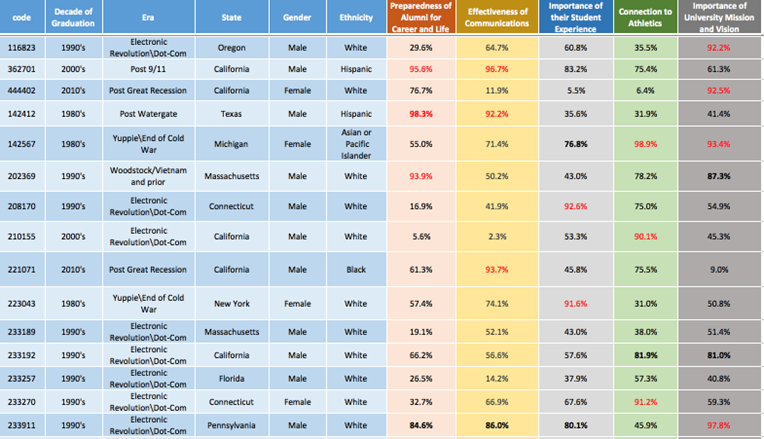

The AAI methodology clusters related survey questions into meaningful indices, each one measuring a specific dimension of the alumni experience or affinity, such as:
Engagement through communications
Preparedness for post-education life
Intensity of the student experience
Feeling informed and connected
Importance of alumni activity and advocacy
Loyalty to academic experience or overall institution
Importance of athletics, mission, or vision
Through statistical analysis, each question “loads” into the index at a unique intensity, resulting in a set of indices that represent the most relevant motivators and differentiators for that institution’s alumni body.
Generating and Using Indices for Maximum Impact
The Alumni Attitude Study analyzes all survey responses to define the most impactful indices for each client institution, supplementing with robust aggregate benchmarks from a large national database. Each respondent receives a percentile ranking for each AAI or Index of Interest, identifying which areas are most salient for that individual compared to peers.
This opens up sophisticated tactical opportunities:
Targeted Messaging: Development officers and communicators can reference an alum’s top indices to choose the subjects most likely to spark engagement, such as leading with athletics when an alumnus ranks in the top 10% for athletics affinity, or focusing on student experience with those most invested in that aspect.
Segmented Stewardship: Cohorts (by class year, ethnicity, donor status, etc.) can be profiled by average rankings, enabling highly relevant appeals and content for each group, even for those who haven’t completed a survey.
Dynamic Scripting: In annual giving calls or outreach, talking points can be adapted on the fly using index rankings or cohort affinities, greatly increasing the odds of meaningful conversation and positive participation.
Transforming Alumni Insight into Action
This indexed, data-driven approach does not connect survey responses back to individuals for privacy; rather, it creates powerful categorical groupings and cohort profiles to enhance both individual and broad strategies.
Key takeaways include:
-Focusing on alumni interests that are proven motivators for each group, rather than guessing or defaulting to generic language.
-Growing institutional knowledge with each new survey, as the density and value of index data compounds over time.
-Providing advancement staff and partners with actionable, granular insights that can drive everything from digital campaigns to major gift strategy.
Practical Examples
Typical indices leveraged by clients include preparedness for life and career, affinity for athletics, connection to the university mission, and communication effectiveness. If an alum’s index ranking puts them in the top percentile for any of these, the content, appeals, and even the tone of the conversation can be custom-tailored, for an experience that feels truly personal.
Institutions can also create visualizations and spreadsheets of cohort averages, empowering teams to run segmented campaigns that reflect the unique voices of young alumni, givers, non-givers, and more.
Alumni Attitudinal Indices and the broader spectrum of Indices of Interest are transforming the way campuses understand and engage their graduates. By grounding strategy in rigorously developed, dynamically updated data models, institutions unlock new heights of relevance, personalization, and long-term engagement. With every survey cycle, this approach only gets stronger, positioning advancement and communication teams to meet alumni where they are and move them to new levels of connection and support.
For more content about alumni engagement data trends, check out our blog Alumni Insights.