

Part 2 of “Rethinking Alumni Strategy: Why Engagement and Giving Belong on the Same Map” Series (Click here for Part 1)
When you combine alumni engagement behaviors (reading communications, attending events, volunteering, advocacy) with giving patterns, you see clear clusters rather than a smooth continuum. In Part 1, we showed how combining engagement behaviors with giving status creates four distinct groups:
High engagement / high giving
High engagement / low giving
Low engagement / high giving
Low engagement / low giving
That simple map helps advancement leaders see where alumni are today and how to move more of them toward deeper engagement and more sustainable philanthropy over time.
Now, we’ll take a closer look at the two low engagement quadrants: Low engagement / low giving and low engagement / high giving. These groups are easy to overlook, yet they represent some of the biggest opportunities to rebuild relevance and broaden relationships before you focus on larger gifts.
The Alumni Attitude Study shows clear differences in how alumni in each quadrant think, feel, and behave. Institutions that plan around these four groups, rather than a single “average alumnus,” are better positioned to respect alumni motivations, allocate scarce staff time, and grow both engagement and giving over time.
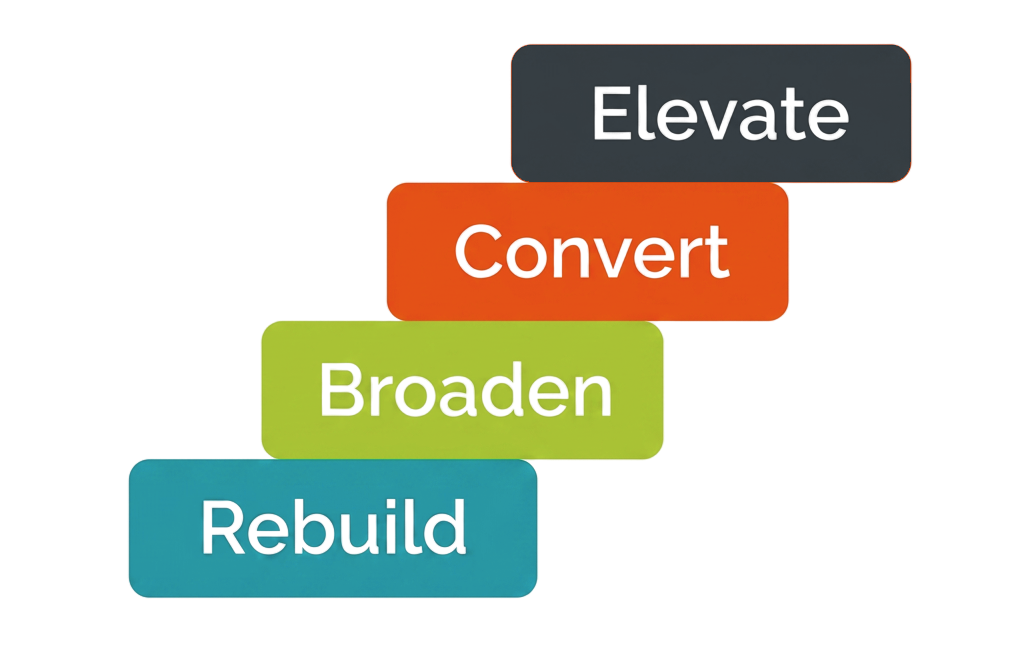

Taken together, these quadrants form a practical ladder:
Rebuild – Low engagement / low giving, where the immediate goal is renewed contact and relevance, not revenue.
Broaden – Low engagement / high giving, extending the relationship beyond the gift.
Convert – High engagement / low giving, turning strong engagement into sustainable philanthropy.
Elevate – High engagement / high giving, moving from donors to leaders and partners.
Here, we focus on the Rebuild and Broaden quadrants and what they mean for your next steps.
Rebuild: Low Engagement / Low Giving
Low engagement / low giving alumni are often the hardest place to start and the easiest group to ignore. They report the lowest satisfaction and loyalty scores, the weakest recommendation rates, and some of the poorest ratings of their alumni experience, yet many still express a desire to believe their degree is valuable and becoming more so.
Behaviorally, they are on the margins: they rarely attend events, volunteer, or consume alumni communications, and many say they never give and do not plan to. However, the story does not end there; they are still interested in invitations, in seeing how other alumni benefit, and in being included, even if they seldom show up.
When they explain why they are not more involved, they mention time and geography, but also say “I don’t know anyone,” “I’m not sure how to get involved,” and that events do not feel worth it. That pattern points to an awareness and relevance challenge as much as a time or capacity problem.
For this group, a traditional annual fund appeal as a first move is like asking a stranger for a favor. The work here is rebuilding the relationship, so they move from “out of orbit” to “back on the radar.”
Practical moves for low engagement / low giving alumni:
-Make it easy to engage: offer short, on‑demand digital content instead of big, on‑campus commitments.
-Lead with nostalgia and identity, such as class year, major, affinity groups, etc. before leading with a case for support.
-Be explicit about the value of each invitation: “Here’s why this is worth 30 minutes of your time.”
-Measure success in opens, clicks, and first small actions, not immediate dollars.
The goal is not to turn them into major donors overnight. It is to re‑establish relevance, so that future engagement and giving asks land in a warmer, more receptive context.
Broaden: Low Engagement / High Giving
Low engagement / high giving alumni can look like a paradox at first glance: they are under‑engaged behaviorally, but they give reliably. In our data, a strong majority of this group are currently giving and plan to continue, even though they participate in events, volunteering, and advocacy less than higher‑engagement groups.
Their sentiment is meaningfully stronger than the low giving cohort, with better overall opinions of the institution, better ratings of their student experience, and higher satisfaction scores. Yet they behave more like “check writers” than community members, maintaining a financial connection without fully stepping into the alumni network.
For this quadrant, the priority is to broaden the relationship beyond the transaction. Done well, that shift not only protects a valuable giving habit but also opens new pathways into mentoring, advocacy, and leadership over time.
Strategies for low engagement / high giving alumni:
-Protect the giving habit with specific impact reporting that shows what their gifts already accomplish.
-Offer one or two structured “engagement upgrades:” donor‑only briefings, small virtual events, or simple volunteer roles that do not demand heavy time or social capital.
-Use segmentation to connect their philanthropy to what they care about, such as scholarships, academic programs, student support, so participation feels relevant, not generic.
-Make the next step obvious and low‑risk, such as: “As someone who already supports students, would you share one piece of advice with the next cohort?”
The main risk with this group is over‑asking in the wrong direction. If the only path you present is “give more,” you may erode a good habit instead of strengthening it, whereas broadening the ways they can engage makes giving one of many expressions of their connection.
What’s Next
Looking across institutions, the exact size of each quadrant shifts, but the pattern holds: alumni are not all at the same stage, and they do not need the same next step. When advancement teams design around the Rebuild and Broaden groups on the ladder, they create room for alumni to re‑enter the conversation long before they are asked for larger gifts.
In the next post in this series, we will turn to the remaining two quadrants: high engagement / low giving and high engagement / high giving. We will explore how to convert strong engagement into philanthropy and elevate donors into long‑term partners and leaders.
For more content about alumni engagement data trends, check out our blog Alumni Insights.